Musicals
| Home | Biography | Novels | Musicals | Contact Me | Links |
| CD | Production Photos |
Book and Lyrics by
Barbara Campbell
Music by Brad Ross
For information on performance rights,
contact Brad Ross:
bradfordwross@gmail.com
- 2026 NYC Off-Broadway production at AMT Theater
- Previous productions at The Barn Dinner Theatre (Greensboro, NC ), Broadway Palm (Fort Myers, FL), La Comedia (Springboro, OH), Chappaqua Performing Arts Center (Chappaqua, NY), Theatre Jacksonville (Jacksonville, FL), Circa 21 Playhouse, Legacy Theatre (Branford, CT)
“A show that surprises with its emotional depth and comedic charm. Delightfully comforting — and sneakily subversive…” Times Square Chronicles
“With witty songs and colorful characters this show...is a cheerful fun entertainment that is perfect for all ages.” TheaterScene.net
"I highly recommend Just Desserts." Broadway World
“What a delicious treat!” Peter Filichia, Broadway Radio
Book and Lyrics by Barbara Campbell - Music by Gary Schocker
- AEA Staged Reading in NYC directed by Hunter Foster.
- Presented at the International Festival of Musical Theatre and the Edinburgh Fringe Festival.
- Showcased at the New York Musical Theatre Festival.
Book and Lyrics by Barbara Campbell - Music by Gary Schocker
- Finalist in the Academy for New Musical Theatre's Search for New Musicals.
- Showcased at Theatre Building Chicago.
- Presented at the International Festival of Musical Theatre as part of the Global Search for New Musicals.
Although Just Desserts, Far from the Madding Crowd, and The Awakening are set in different worlds and in different centuries, they are all stories of personal transformation. It might occur at a present day county fair, in rural England at the dawn of the Industrial Revolution or at the brink of a new century in New Orleans. Just Desserts is a comedy, while Far from the Madding Crowd and The Awakening are dramas, but the characters in these stories face many of the same issues we do: the search for personal value, the conflicting demands of society and self, and the struggle to make the right choices about the direction of our lives.

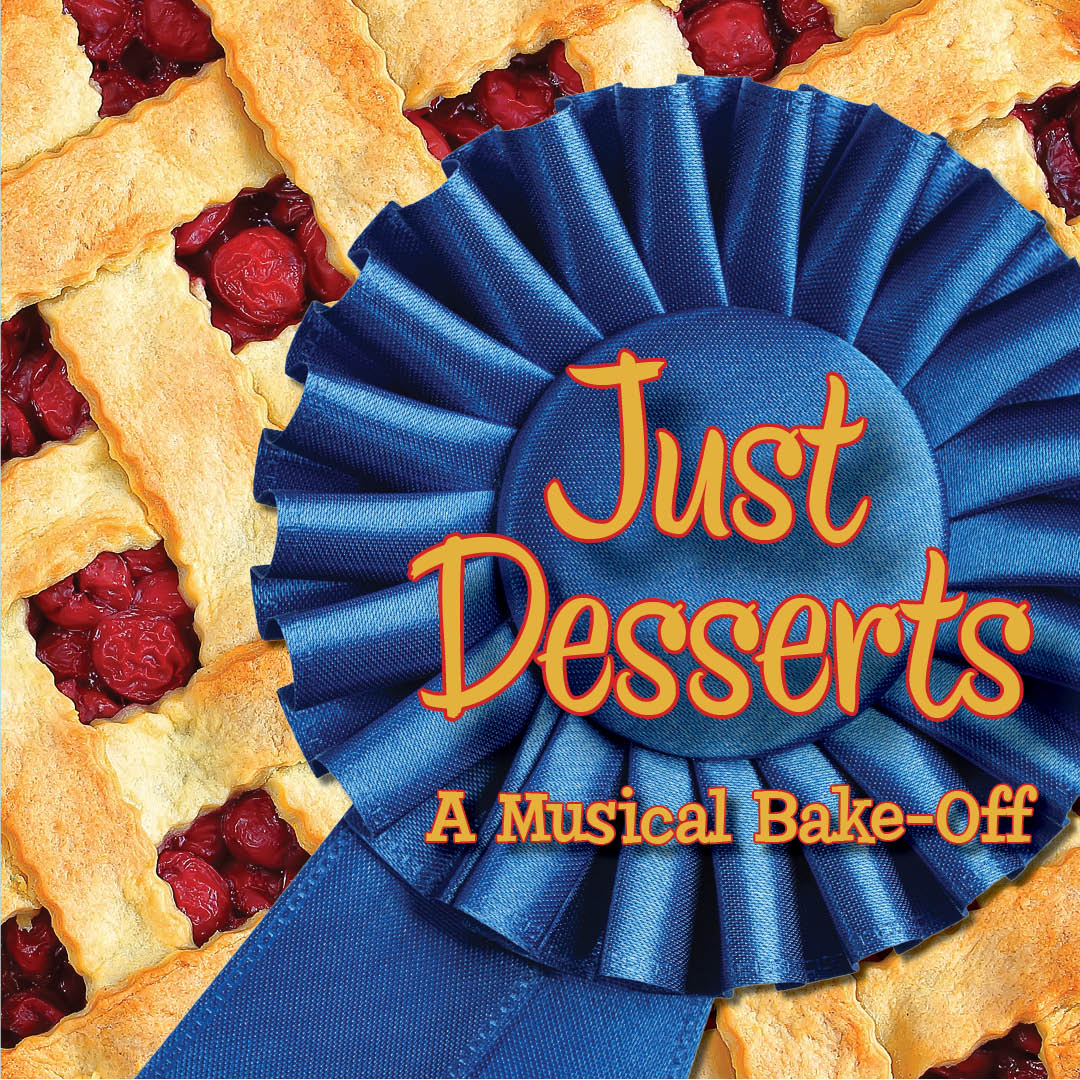
Just Desserts: A Musical Bake-Off
This is it! Almost bake time.
This is it! Make or break time.
One more round and I'll reach the top.
What a dream to be cream of the crop...
It’s sweet. It’s savory. It’s five strangers
putting their hearts, reputations, and baking skills on the line to become
the crème de la crème of bakers at a county fair.
A determined young woman dreaming of opening her
own bakery. A twice-divorced nail technician who wants to fit in with her
boyfriend’s circle of friends. A shy school nurse who is torn between
family obligations and a desire to participate. A mysterious man from
Brooklyn whose presence arouses suspicion. And the reigning champion who
disguises her ruthless drive to win with smiles and pleasantries.
Listen to:
Blair Goldberg (Kinky
Boots) performing “Make it Big”: https://youtu.be/ltdSr1QW0sg
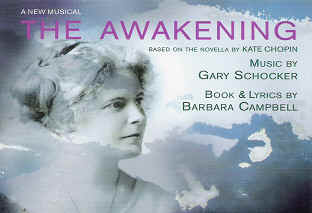
The Awakening
And always the sea - beckoning.
Always the sound - rumbling.
Lingering, lost in the roots of a tree.
Waiting for me,
Waiting like me...
For years, Edna Pontellier has tried to be a good wife and a loving mother like the other Creole matrons, to still her restlessness and her yearning for something more. On Grand Isle, she takes the first tentative steps towards discovering herself - as a woman, as an artist, as a person. The Awakening follows Edna's journey - at once joyous and painful - and the difficult choices she must make in her struggle to live an authentic life.
Published in 1899, Kate Chopin's novella was denounced as shocking and immoral. Not only did Chopin create a woman who valued herself first as a person and second as a mother, but she dared to explore a woman's sexual nature with a candor that even writers of the naturalist school did not attempt.
For The Awakening, we created a score that contrasts the dream-like quality of Edna's inner life with that of the conventional world around her. From the isolated splendor of Grand Isle to the glittering salons of New Orleans society, Edna pits herself against nature and society in her quest to find fulfillment.
Listen to:
Always
the Sea
Emily Skinner
Dimanche
Après-midi
LaChanze, Ensemble
When
I Touch the Keys
Ann Hampton Callaway, Emily Skinner
After
Midnight
David Masenheimer, Peter Lockyer, Doug LaBrecque
You
Are the Sea
Emily Skinner, Ensemble
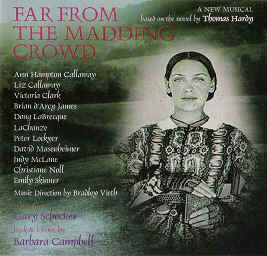
Far from the Madding Crowd
There's a time for joy and a time to weep.
What you plow and plant you are bound to reap
As the wheel of the year turns on...
Far from the Madding Crowd charts the tempestuous journey of Bathsheba Everdene as she attempts to find her place in a society that rigidly dictates women’s roles and behaviors. Although she is successful in managing the farm she inherits, she finds it more difficult to control the vagaries of her heart. A girlish prank sets in motion events that build inexorably to tragedy and to Bathsheba’s ultimate discovery of love.
In adapting Thomas Hardy's novel for the musical theatre, we quickly jettisoned many of the qualities he ascribed to Bathsheba, including her vain and frivolous nature. What drew us to the project was Bathsheba's independent spirit and her struggle to succeed on her own terms, a journey that we believed would resonate with modern audiences.
We preserved some of the novel's humor through the wry observations of the chorus. Adding traditional English folk songs to our original material allowed us to capture the timelessness of rural life where "nothing ever changes but the seasons/nothing ever passes but the time." But even when he wrote Far from the Madding Crowd, technological and social innovations had begun to change Hardy's beloved "Wessex." The romantic complications at the heart of the musical mirror this transformation.
The staging uses minimal props and set pieces, leaving the audience to imagine the farm and the landscape, and freeing them to concentrate on the interaction of the characters.
Listen to:
Wonder
What She'd Tell Me Now
Liz Callaway
Fanny
Christiane Noll
A
Few Hours More
Brian d'Arcy James, Liz Callaway, David Masenheimer, Doug
LaBrecque, Ensemble
After
All
Liz Callaway